Burned Bread
The burned bread is a seemingly insignificant piece of scorched food that becomes one of the most consequential objects in Katniss Everdeen's life, embodying an act of anonymous kindness that saved her family from starvation and created an unpayable debt that shapes her relationship with Peeta Mellark throughout the Seventy-fourth Hunger Games.
Origin and the Act of Giving
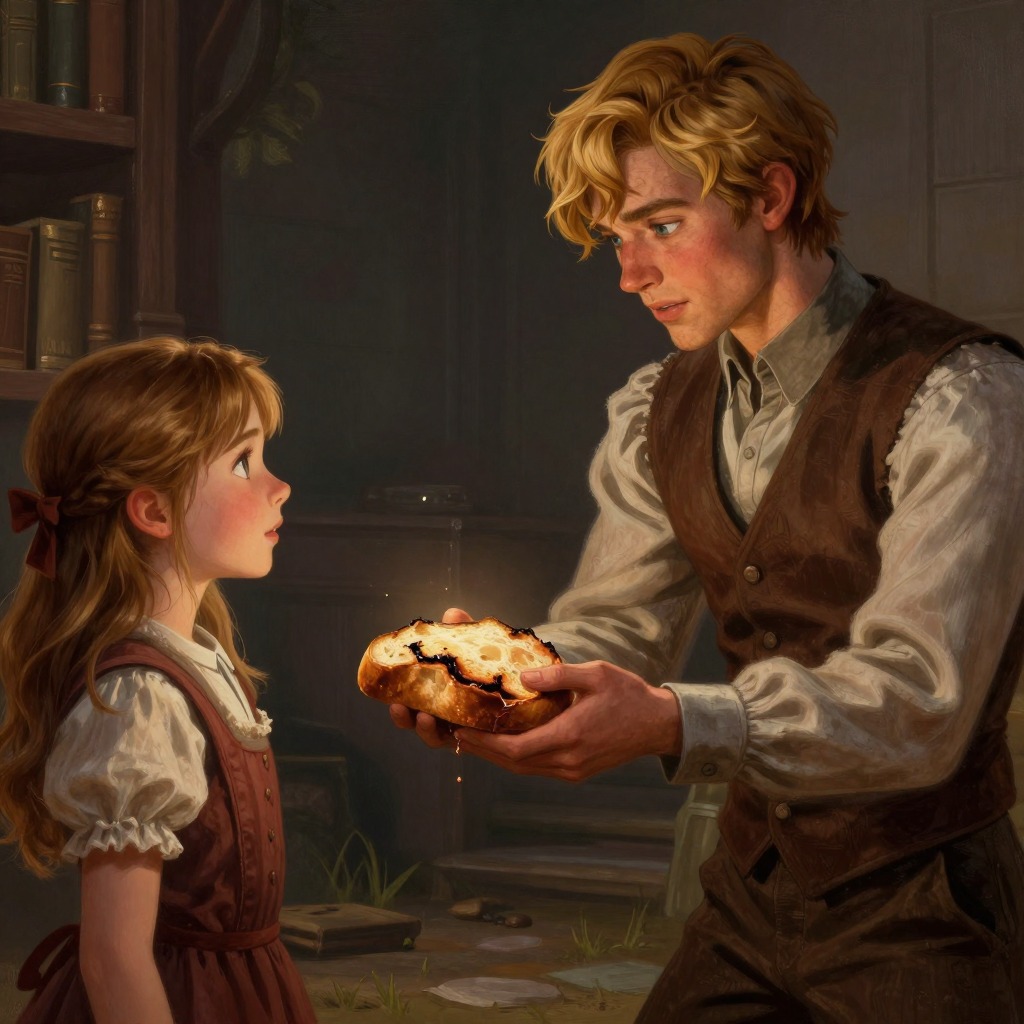
The burned bread appears during the worst period of Katniss's life, three months after her father was killed in a mine explosion. With her mother catatonic with grief and unable to function, eleven-year-old Katniss had become the sole provider for herself and her seven-year-old sister Prim. By the time of the encounter, the family had been surviving on nothing but boiled water with dried mint leaves for three days. Desperate and starving, Katniss found herself behind the shops in the merchant section of District 12, drawn by the smell of fresh bread from the bakery. When she checked the baker's trash bin, she found it "spotlessly, heartlessly bare." The baker's wife drove her away with ugly words, threatening to call the Peacekeepers. Katniss collapsed against an old apple tree, too weak and sick to continue, wishing she could die right there in the rain. From behind his mother's back, a boy with blond hair—Peeta Mellark—had been watching. After his mother went inside to serve a customer, he deliberately dropped two large loaves of bread into the fire, scorching the crusts black. His mother screamed at him to "feed it to the pig," and he began tearing off the burned chunks and tossing them into the pig trough. But when his mother disappeared, he threw both loaves directly to Katniss without ever glancing her way, then returned to the bakery and closed the kitchen door tightly behind him. Katniss shoved the loaves under her shirt and walked swiftly away, the heat of the bread burning into her skin as she clutched it "clinging to life."
Immediate Consequences and Sustenance
The bread had immediate, life-saving effects. When Katniss reached home, the loaves had cooled somewhat but the insides were still warm. She made her mother join them at the table, poured warm tea, scraped off the blackened crusts, and sliced the bread. It was "good hearty bread, filled with raisins and nuts." The family ate an entire loaf, slice by slice. Katniss put her clothes to dry at the fire, crawled into bed, and fell into a dreamless sleep. The next morning, they ate slices of bread for breakfast and headed to school. It was as if spring had come overnight—warm sweet air and fluffy clouds. At school, Katniss passed Peeta in the hall; his cheek had swelled up and his eye had blackened from the beating his mother had given him for burning the bread. He was with his friends and did not acknowledge her in any way. But as she collected Prim and started for home that afternoon, she found him staring at her from across the school yard. Their eyes met for only a second before he turned away. That was when Katniss saw the first dandelion of the year, which reminded her of the hours spent in the woods with her father and showed her how they were going to survive.
Symbolic and Emotional Resonance
The burned bread becomes a permanent touchstone in Katniss's consciousness, inextricably linking Peeta Mellark to hope and survival. She reflects that she can "never shake the connection between this boy, Peeta Mellark, and the bread that gave me hope, and the dandelion that reminded me that I was not doomed." More than once in the school hallway, she caught his eyes trained on her, only to quickly flit away. She feels she owes him something, and she hates owing people. The bread also catalyzed Katniss's transformation into a hunter and provider. After seeing the dandelion, she plucked it carefully and hurried home, grabbed a bucket and Prim's hand, and headed to the Meadow, which was dotted with the golden-headed weeds. That night they gorged themselves on dandelion salad and the rest of the bakery bread. Prim asked what other food they could find, and Katniss promised her "all kinds of things." She retrieved her father's book of edible plants, and the next day she worked up the courage to go under the fence into the woods alone for the first time, retrieving the small bow and arrows her father had made her. She killed a rabbit on her own, and the sight of the meat stirred something in her mother, who roused herself to make a stew. The woods became their savior, and Katniss kept them alive.
The Debt and Its Reckoning
The burned bread creates a moral economy that Katniss struggles with throughout the Games. When Peeta is chosen as the male tribute, Katniss immediately thinks of the bread and wishes she had thanked him at some point, but the opportunity never seemed to present itself. Now they will be thrown into an arena to fight to the death, and she wonders "exactly how am I supposed to work in a thank-you in there? Somehow it just won't seem sincere if I'm trying to slit his throat." Later, when Peeta insists on cleaning up the vomit-covered Haymitch, Katniss realizes he is being kind, just as he was kind to give her the bread. The idea pulls her up short: "A kind Peeta Mellark is far more dangerous to me than an unkind one. Kind people have a way of working their way inside me and rooting there." She decides to have as little as possible to do with him, but the bread's legacy cannot be escaped. In the cave, when Peeta is dying from blood poisoning, Katniss finally articulates the debt: "It's like the bread. How I never seem to get over owing you for that." Peeta dismisses it, saying they can let it go since she just brought him back from the dead, but Katniss insists: "But you didn't know me. We had never even spoken. Besides, it's the first gift that's always the hardest to pay back. I wouldn't even have been here to do it if you hadn't helped me then." When she asks why he did it, Peeta's answer is oblique but profound: "You know why." The bread, then, is not merely food but the foundation of a relationship that transcends the Games' demand that they kill each other, ultimately enabling their joint victory.